Introducing darkshift and Infrared

We're darkshift, the team behind Kubefirst, Konstruct and Colony. We've run Kubernetes in production since 2017. In that time we've built public and private clouds, run the enterprise platforms on top of them, and written installers that take an empty cloud account to a full platform in one command. Today we're introducing the company and its first product, Infrared: a gitops control plane where humans and agents work on software together, through one change flow.
Why we built it
Agents write code now. Most teams' change process wasn't built for that. Code review assumes a person wrote the diff, a person can explain it, and the reviewer can read every line of it. When agents open a lot of pull requests, that model breaks in one of two ways. Either review becomes a rubber stamp, or the humans become the bottleneck and the agents wait.
We think the answer is not a separate lane for agents. It's one change flow that every Change goes through, whoever wrote it:
- The same reviews.
- The same evidence.
- The same promotion through environments.
- The same human approval before anything ships to production.
The difference is what the human approves from. A diff alone doesn't show whether a change works. Proofs do: what each review step concluded, the screenshots and video of the change running, the test and coverage reports, and a screenshot of each environment the Release made Healthy.
What Infrared is
You install Infrared on a Kubernetes cluster with one helm install. The setup wizard does the rest:
- It creates a GitHub App for your organization. There are no personal tokens to paste.
- It hydrates a gitops repo from a template.
- It installs Argo CD and syncs the repo in sync-wave order.
- It lets Argo CD adopt Infrared itself.
From then on, everything, Infrared included, is managed through pull requests to that repo.
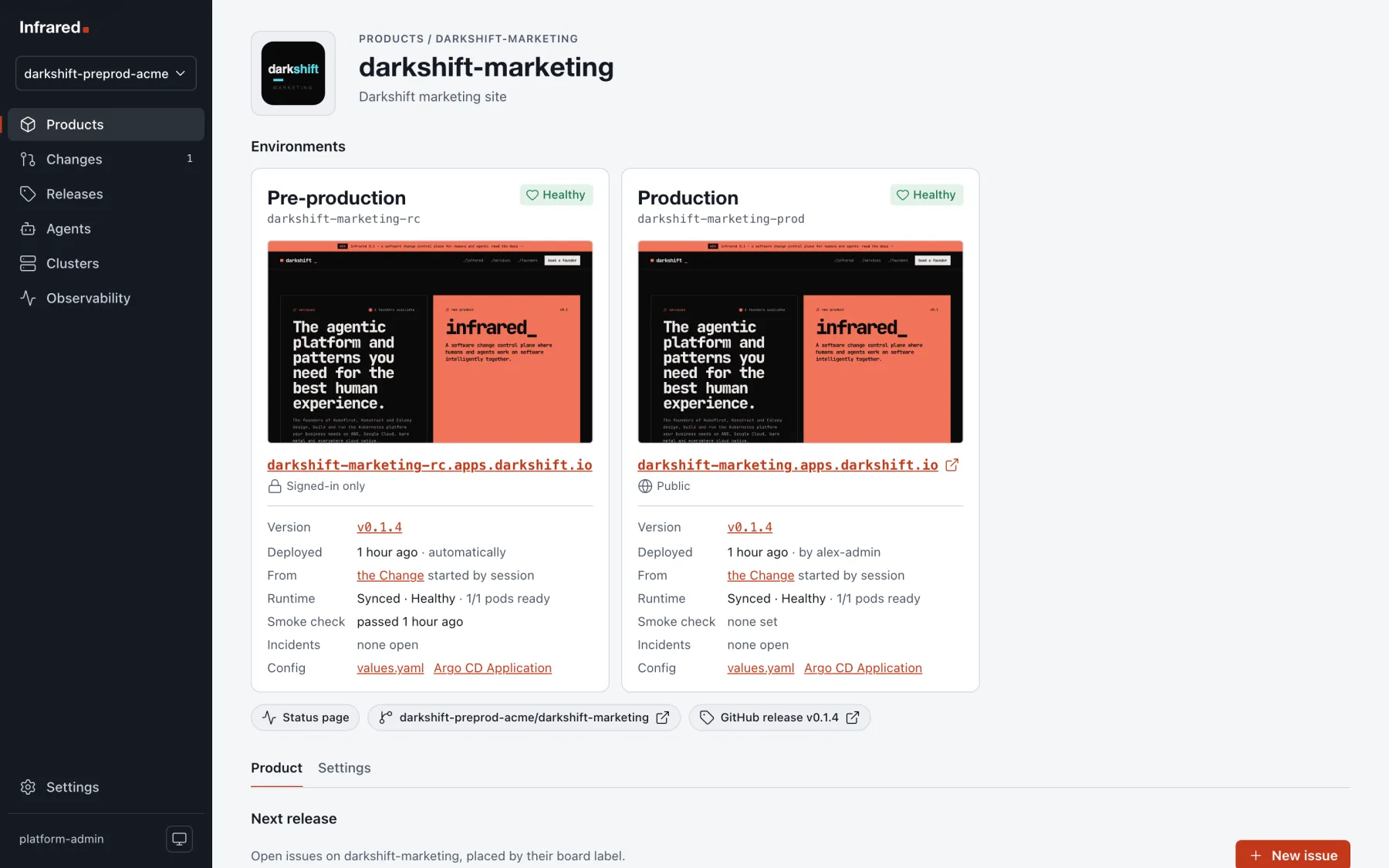
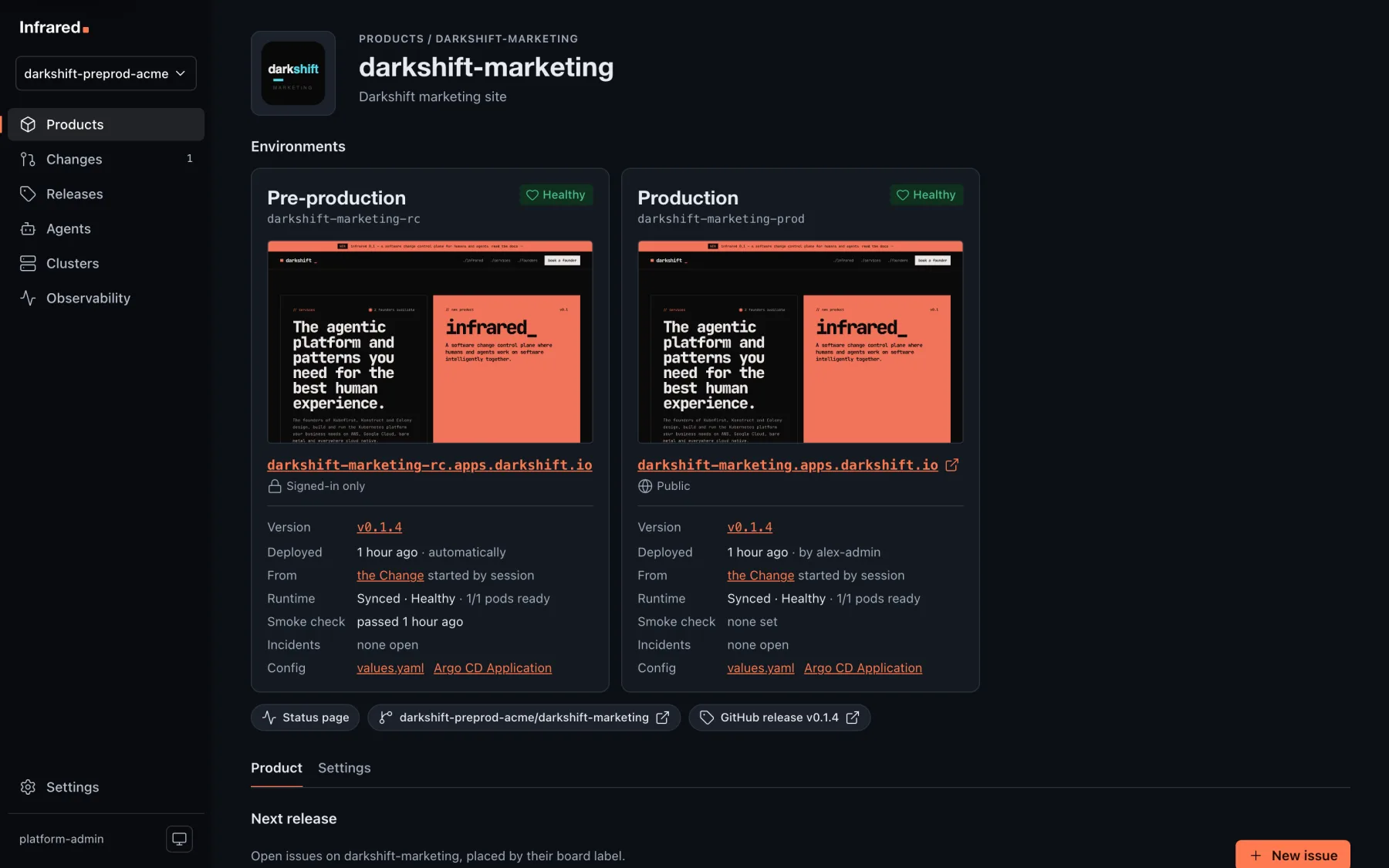
It starts from the Product, not the cluster. A Product is the repos you build, release and change together. Its page shows:
- its environments and what each one runs;
- the board of work for the next release;
- its Releases;
- who has been working on its repos.
Clusters, zones and gitops plumbing are there to serve the Product.
Agents do defined jobs. Humans hold the gates. A Change moves through an AgentWorkflow, an ordered list of steps.
- Most steps run an AgentRole: a defined job such as the security reviewer, the end-to-end verifier or the version manager.
- Some steps are human approval gates.
Every AgentWorkflowRun records what each step did, the verdict it reached, the model it used and what that cost, and the evidence it captured. Infrared ships a full catalog of AgentRoles. Each org gets its own copy, and every opinion an AgentRole follows can be read, edited or switched off in the UI.
Releases are promotions, not deploys. Infrared builds each Product in the cluster with kpack and cuts the tag. It then promotes the build zone by zone, pre-production first. Each zone's pinned image changes only through a pull request to the gitops repo, after a smoke check. Production zones also wait for a human approval by default.
And it watches what it ships. Each Product gets:
- SLOs with error budgets and burn alerts;
- incidents;
- DORA metrics;
- a status page, signed-in only or public.
We run on it
darkshift.io is a Product in Infrared. The page you'd find there was uploaded as a zip, built by kpack and released to a pre-production zone behind Infrared sign-in. A person approved it before it was promoted to production at the apex domain. The screenshots in these docs come from the same installation.
What you can run today
Infrared is on the 0.1 track, in alpha. Pre-releases ship as 0.1.0-alpha.N, and 0.1.0 itself is reserved for the first release. Each phase of the roadmap has working pieces in 0.1:
- Install and bootstrap: helm install, the setup wizard, the GitHub App, gitops repo hydration and Argo CD adoption.
- Orgs and access: teams by GitHub login, four roles, and sign-in with GitHub.
- Clusters: workload clusters registered by kubeconfig or built from a cluster template, with per-org allowlists.
- Products and delivery: a Product from existing repos, a template or a zip. It also covers environments, custom domains and zone-by-zone Releases.
- Change management: AgentWorkflowRuns executed in-cluster, human gates, a backlog board that agents help fill in, and evidence on every Change.
- Observability: SLOs, incidents, DORA metrics and status pages.
Each phase also lists what isn't there yet: SSO, secrets in Infisical, per-zone environment variables, AgentRole tailoring from your repos and more. We'd rather tell you than have you find out.
Try it, or talk to us
- Read What is Infrared? and the architecture.
- Install it on a single k3s node with Install on k3s.
- If your company needs a mission-critical platform built on AWS, Google Cloud or bare metal, our founders take a small number of full-time engagements. Find us at darkshift.io or write to hello@darkshift.io.
We'll post here as Infrared moves toward 0.1.