Hero Goggles, our day at the Cloud Native Hackathon

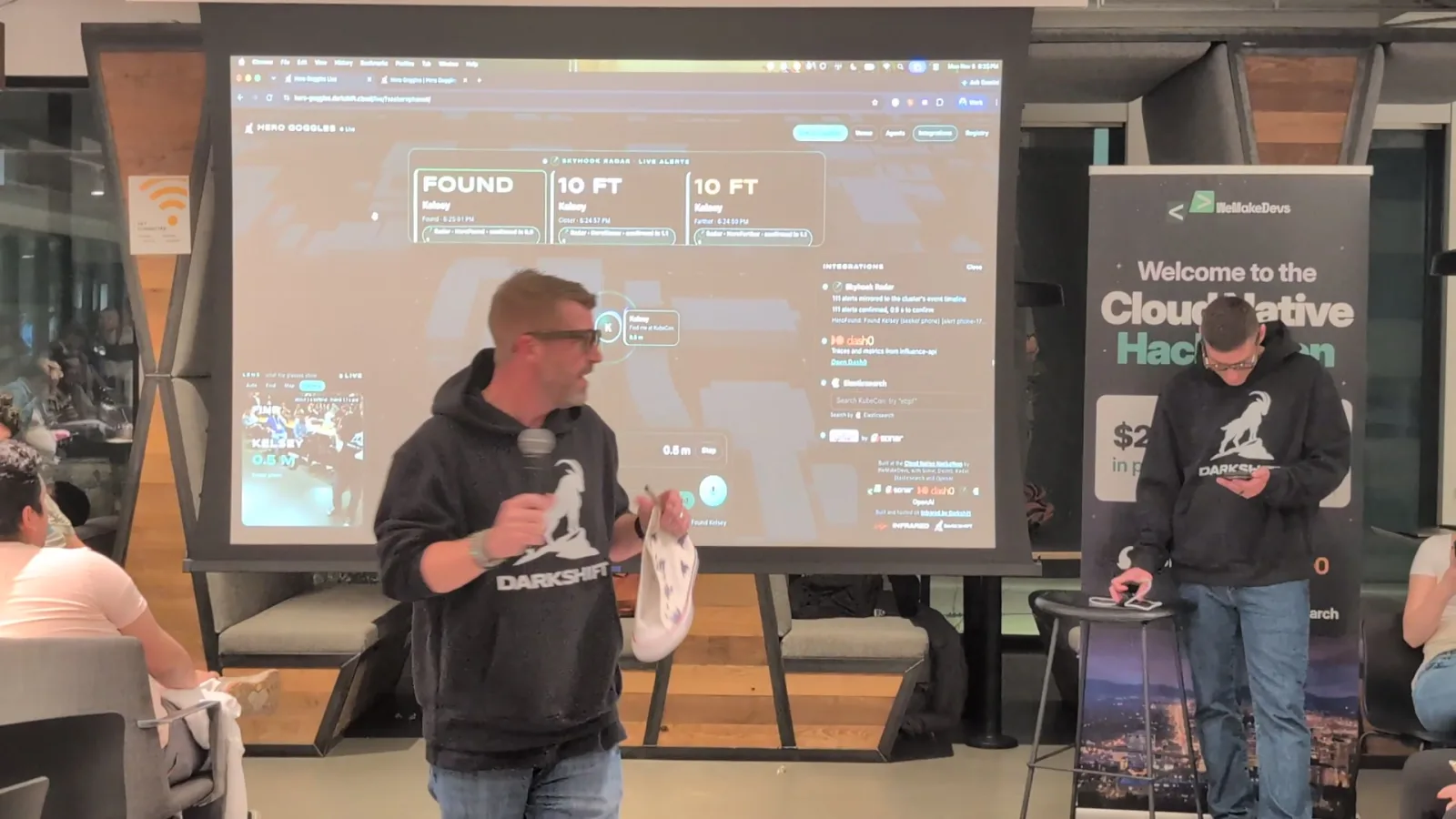
On Monday, November 9, the two Darkshift cofounders walked into The Shop Workspace in Salt Lake City for WeMakeDevs' Cloud Native Hackathon, the day before KubeCon + CloudNativeCon North America 2026 opened across the street. We left with a working product, five public repositories, a film, and the Loudest Applause award.
This post is what we built, how each sponsor's product sits at the heart of it, and how Infrared built, shipped and hosted every piece.
The Hero Goggles film, 77 seconds, sound on · ⤢ Watch fullscreen
The idea
KubeCon puts ten thousand humans in one building, and most of them came to meet a few of the others. Hero Goggles finds them for you.
The person you want to meet carries a small Ultra Wideband (UWB) beacon. Your iPhone ranges it and tells you how far away they are and which way to turn: on the phone, in the lens of Meta Ray-Ban Display glasses, and out loud. Every reading also reaches a live map of the Salt Palace that anyone can open. On the day, the two people we set out to find were Kelsey Hightower and Kunal Kushwaha, each with a beacon registered to them.
- In the lens: a web app for Ray-Ban Display with a list, a map and Find, driven by the Neural Band. The glasses allow 300 KB and 15 requests on first load; the app's first load is under 15 KB.
- On the iPhone: the app ranges the beacon over UWB with Apple's Nearby Interaction, draws the seek in the lens through Meta's Wearables Device Access Toolkit, and says the distance aloud.
- On the map: hero-goggles.darkshift.cloud/live/ shows the venue, the beacons, who is seeking whom, the registry, a profile page per influencer, and Find by voice.
- For agents: the API serves its actions as MCP tools, so
claude mcp add --transport http influence https://influence-api.darkshift.cloud/mcplets Claude Code find Kunal for you. The map hands the same tools to an agent in the browser through WebMCP.
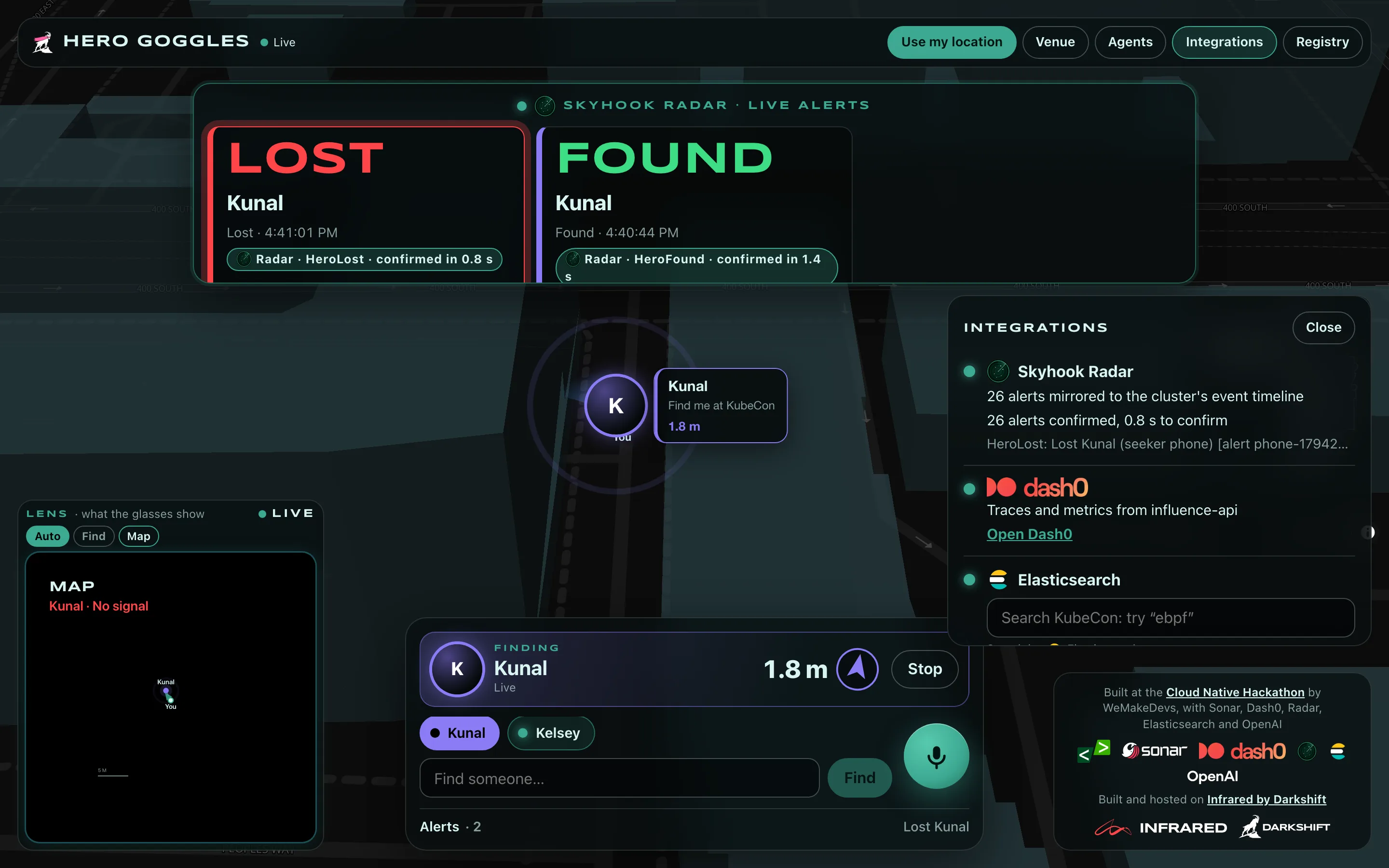
A find works like this. Someone says who to find, on the glasses, by voice on the map, or through an agent. The API sets that seeker's target. The iPhone ranges the target's beacon and posts each reading, and the API fires an alert as you cross 50, 30, 20, 10 and 5 feet, another when you are within 3 feet, and one more if the signal is lost. The lens and the map show each alert as it lands.
Four sponsors, four deep integrations
The hackathon had four sponsor tracks. We did not want a logo on a slide for each. We wanted each product doing real work inside Hero Goggles, so that taking it out would break something.
Skyhook Radar: every alert, confirmed
Radar, Skyhook's open source Kubernetes UI with an AI SRE, watches the namespaces Hero Goggles runs in, read-only. A small bridge mirrors each distance alert into the cluster's event timeline, where Radar sees it, and Radar's confirmation comes back to the API with the alert's id. The lens and the map then mark the alert as confirmed by Radar, with how long confirmation took. On the afternoon this post was written, the map showed 26 alerts mirrored and 26 confirmed, in 0.8 seconds. Radar's mark sits on the live alert strip, on every confirmed badge and in the integrations panel.
Elasticsearch: all of KubeCon, one search away
Elasticsearch 9 holds every KubeCon session and speaker from the schedule, 600 sessions and 712 speakers. It is behind the map's search box, the API's /api/search and the search MCP tool, so a human and an agent ask the same index the same question. Search for "ebpf" and you get the talks, their rooms and times, and the humans giving them.
Dash0: never flying blind
The API sends its traces and metrics to Dash0 over OpenTelemetry. Each find, reading and alert runs inside a span with a stable name (influence.find, influence.reading.ingest) and the attributes a person would filter by, never a secret or an email address. Counters and histograms follow one naming rule, so a failure at 3 a.m. comes with a trace id. Dashboards kept as code in the repository are next.
Gitar by Sonar: never merge broken
Gitar reviews every pull request on Hero Goggles against one rule we wrote for it, .gitar/rules/instrumentation.md: a pull request that adds a route, a feature or a background job must trace it, measure it, show it on the dashboard, and log what a human needs at 3 a.m. A pull request that adds behaviour without all four is not ready, and Gitar says which one is missing. The rule ties Gitar and Dash0 together: Gitar makes sure every new thing reaches Dash0.
Thank you as well to OpenAI, which sponsored the day and gave every builder credits. Hero Goggles does not use OpenAI's models, so we thank it here rather than claim an integration.
Built with Claude, shipped and hosted on Infrared
We wrote the code with Claude Code. Everything that runs, Infrared built, shipped and hosts, on Infrared's hosted control plane, in an org of its own, save-the-world-org.
- Every app is a Product. hero-goggles (the glasses app and the live map), influence-api (the API) and hero-goggles-docs (the docs site and the film) are each a Product with a production zone and a public address under
darkshift.cloud. One more, influence, was the first version of the map; when the map moved into hero-goggles, its Product was deleted. - From a push to the internet. A deployment builds the repository with Paketo buildpacks, tags a Release, promotes it into the zone through the gitops repo, runs the smoke check and holds under the release guard. When the hackathon clock was short, Go now ended a hold early, and the guard still read the zone's error budget and ran its checks once more before moving on.
- Sandboxed. The org's pods run under GKE Sandbox (gVisor), fenced from every other org on the plane. Elasticsearch, Kibana and Radar run beside the Products.
- Read and summarised. Infrared's code index reads all five public repositories, so an agent can answer how Hero Goggles works from the code, citing the commit. At the end of the day, Infrared made the org's daily summary film, told Product by Product, with screenshots of each live site, the features merged, the DORA numbers and who built them.
By the numbers, on the day: 29 deployments across four Products, 27 of them Released, from about 70 commits by the two of us and Infrared's own bot.
What the day taught us about Infrared
Building a real product against a clock on our own hosted control plane found things we would rather fix than hide.
- A Node.js Product picked the newest Node, which needs a library the run image does not have. Pinning Node 22 works around it; the fix belongs in the starter or the run image.
- Elastic's operator cannot run under GKE Sandbox, because GKE turns each volume's name into an annotation key and the operator's volume names make keys that are too long. We ran Elasticsearch 9 directly, which under gVisor needs one extra JVM flag to boot.
kubectl port-forwardcannot reach a pod under gVisor, and an org's own tools, such as Radar and Kibana, cannot yet get an address behind Infrared's sign-in.- A merge made outside an AgentWorkflowRun starts no deployment by itself: run
ir deployment new --product <name>after it. - Deleting a Product could leave its zone's namespace coming back. That one is fixed: Infrared 0.1.6 shipped the fix the same evening, along with the daily summary told by Product.
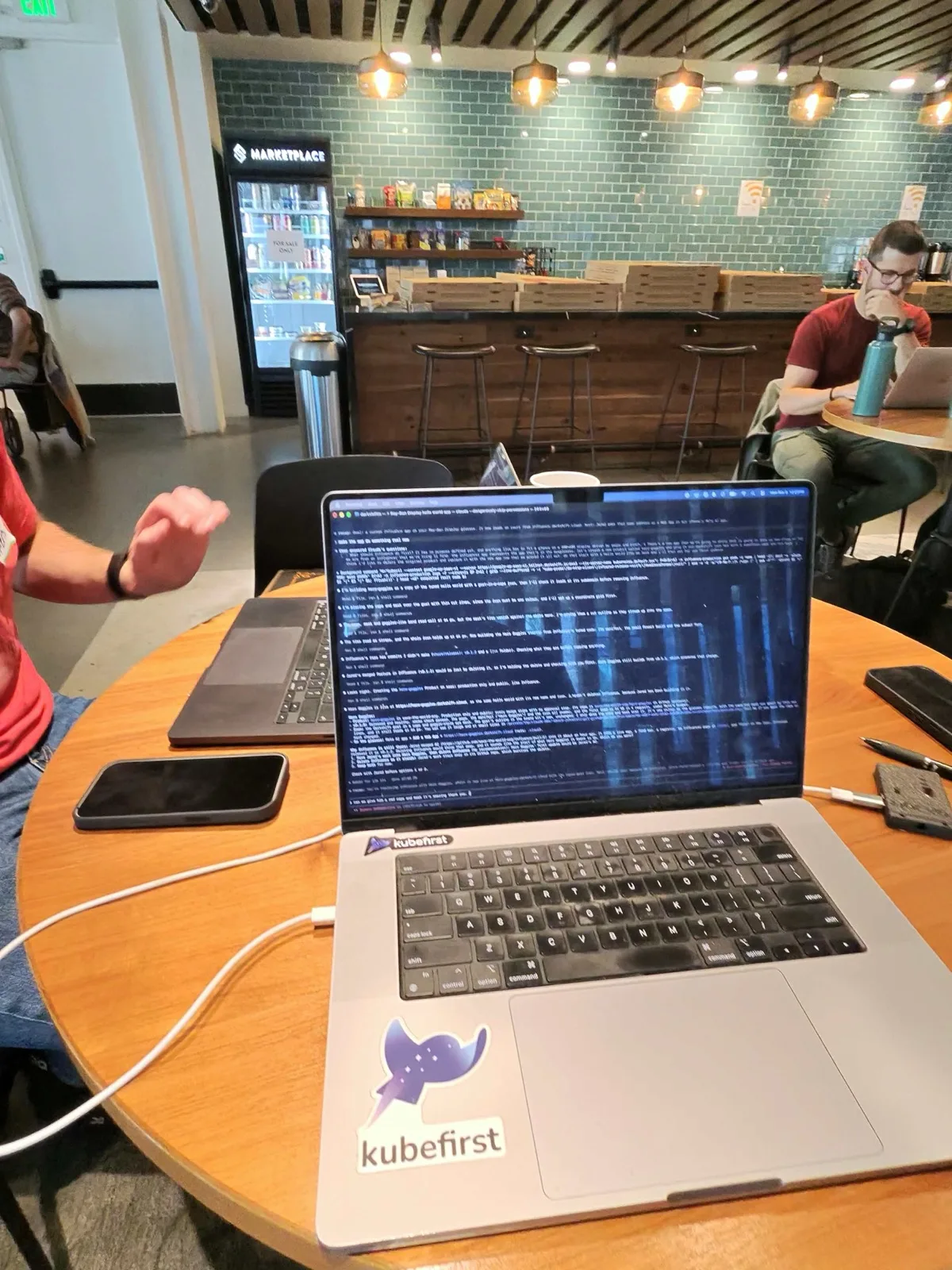
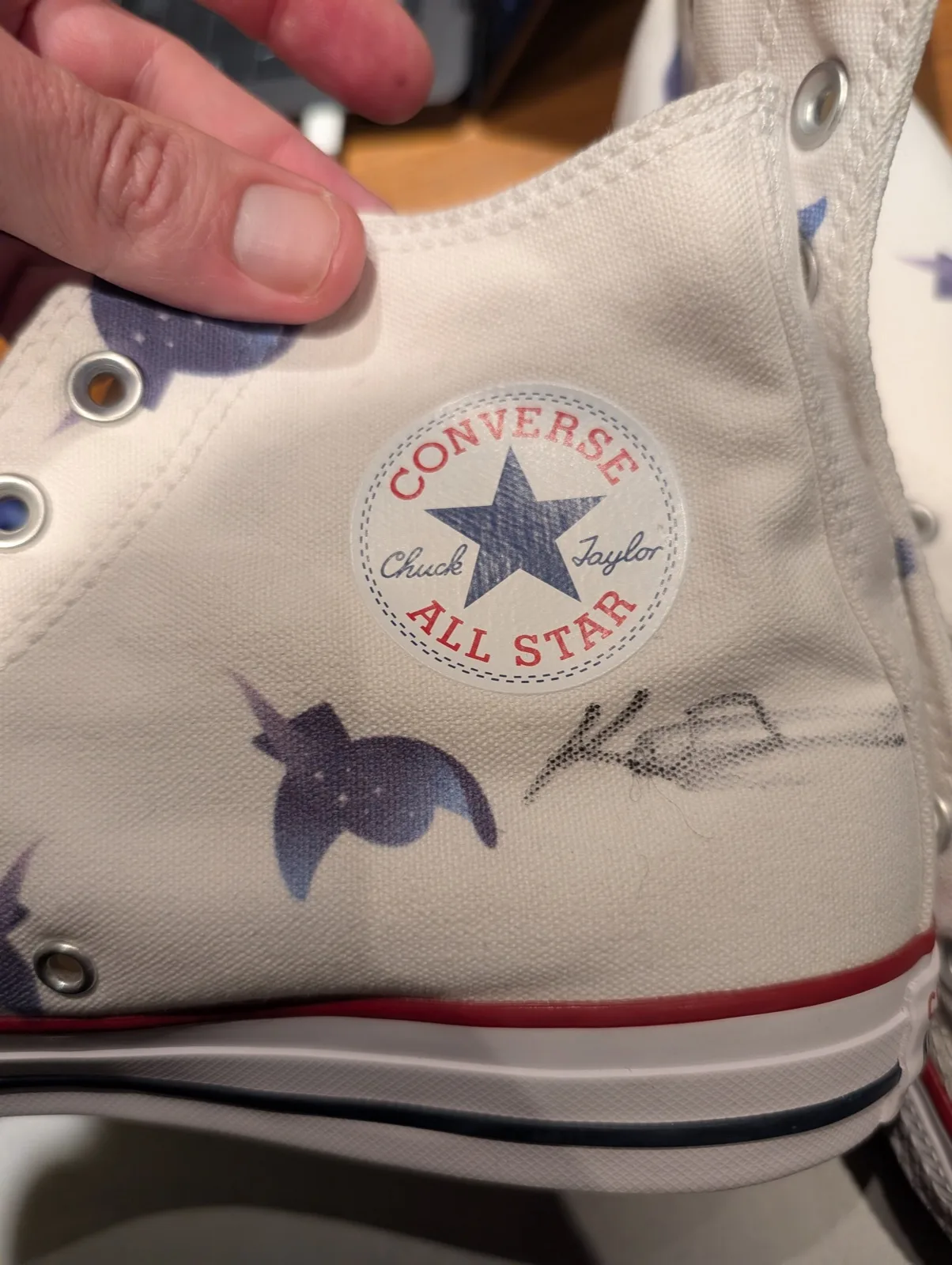
From the room
Thank you
To WeMakeDevs and Kunal Kushwaha, for hosting a room full of builders. To Sonar, Dash0, Skyhook Radar, Elastic and OpenAI, for backing the builders, and to Keychron, NVIDIA and Kelsey Hightower for the prizes. To Merge Forward, for asking every project to make conferences work for everyone. And to every team in the room.
See it
- The live map: hero-goggles.darkshift.cloud/live/
- The docs: hero-goggles-docs.darkshift.cloud, with every repository
- The showcase: darkshift.io/hackathon/hero-goggles
- The code: github.com/save-the-world-org
Hero Goggles is the first app of Save the World, Darkshift's mission to take the complexity out of building and running software, with everyone fighting it, and to put what we build in the hands of real humans. If you want Infrared building and hosting your next product, book a call.